
Tell the problem with the code?

#include
#include
using namespace std;
int maximum_value(int input[],int i,int j,int count)
{
if(i==j-1)
return max(input[i],input[j]);
if(input[i]>input[j])
{
if(count%2==0)
return input[i]+maximum_value(input,i+1,j,count+1);
else
return maximum_value(input,i+1,j,count+1);
}
else
{
if(count%2==0)
return input[j]+maximum_value(input,i,j-1,count+1);
else
return maximum_value(input,i,j-1,count+1);
}
}

int main()
{
int n;
cin>>n;
int arr[30];
for(int i=0;i<n;i++)
cin>>arr[i];
cout<<maximum_value(arr,0,n-1,0);
return 0;
}

Hello @namangarg31,

The logic you have applied won’t help.
It is a tricky question.
Let’s understand the question and its solution in detail.
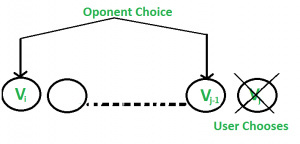
There are two choices:

  1. The user chooses the ith coin with value Vi: The opponent either chooses (i+1)th coin or jth coin. The opponent intends to choose the coin which leaves the user with minimum value.
    i.e. The user can collect the value Vi + min(F(i+2, j), F(i+1, j-1) )

  1. The user chooses the jth coin with value Vj: The opponent either chooses ith coin or (j-1)th coin. The opponent intends to choose the coin which leaves the user with minimum value.
    i.e. The user can collect the value Vj + min(F(i+1, j-1), F(i, j-2) )
    image

Following is recursive solution that is based on above two choices. We take the maximum of two choices.

F(i, j) represents the maximum value the user can collect from
i’th coin to j’th coin.

F(i, j) = Max(Vi + min(F(i+2, j), F(i+1, j-1) ),
Vj + min(F(i+1, j-1), F(i, j-2) ))

Base Cases

F(i, j) = Vi If j == i
F(i, j) = max(Vi, Vj) If j == i+1

explanation:
Let’s understand this:
let the index at which the leftmost coin is available be l (initially 0)
and the index at which the rightmost coin is available be r (initially n-1)

  1. if piyush chooses l
    then in the next pick he will have two possible choices:
    (l-1,r-1): the opponent has selected the rightmost coin
    (l-2,r): the opponent has selected the leftmost coin.
    sum= arr[l]+min(fun(l-1,r-1),fun(l-2,r))
    opponent will choose something that will cause piyush to have minimum sum.
  2. if piyush chooses r
    then in the next pick he will have two possible choices:
    (l-1,r-1): the opponent has selected the leftmost coin
    (l,r-2): the opponent has selected the rightmost coin.
    sum= arr[r]+min(fun(l-1,r-1),fun(l,r-2))
    opponent will choose something that will cause piyush to have minimum sum.

Hope, this would help.